AtaGenix Laboratories

AtaGenix Laboratories
Release time: 2026-01-14 View volume: 1359
Project Snapshot — An Advanced Science study (IF: 14.3) identified USP8 as the core deubiquitinase governing MDA5 homeostasis, revealing an AKT–USP8–MDA5 regulatory axis that drives type I interferon signaling and MDA5-associated autoimmunity. AtaGenix provided a custom phospho-specific antibody against human USP8 Ser718, enabling precise detection of AKT-dependent USP8 phosphorylation dynamics — a key experimental tool for validating this therapeutic axis.
Based on: Zhang Q et al., Advanced Science, 2025;12(34):e03865 — DOI: 10.1002/advs.202503865
Melanoma Differentiation-Associated protein 5 (MDA5) is a cytoplasmic RNA sensor that initiates type I interferon signaling against RNA viruses. However, its aberrant activation — via viral infection or gain-of-function mutations — can drive autoimmune diseases such as Aicardi–Goutières syndrome (AGS) and anti-MDA5-positive dermatomyositis (DM), with limited effective treatments available. While deubiquitinases play crucial roles in immune signal regulation, the specific deubiquitinase governing MDA5 homeostasis had not been defined.
Published in Advanced Science, this study identifies ubiquitin-specific protease 8 (USP8) as the core deubiquitinase regulating MDA5 homeostasis. The authors demonstrate that AKT directly phosphorylates USP8 at Ser718, enhancing USP8 activity and strengthening its association with MDA5 to form the AKT–USP8–MDA5 regulatory axis. In preclinical models, inhibiting USP8 or AKT promotes degradation of pathogenic MDA5 and dampens excessive immune signaling, supporting this axis as a potential therapeutic entry point for MDA5-associated autoimmune diseases.
Step 1: Viral infection activates AKT, which phosphorylates USP8 at Ser718, strengthening the USP8–MDA5 interaction.
Step 2: USP8 deubiquitinates and stabilizes MDA5, promoting type I interferon production.
Step 3: Inhibiting USP8 or AKT facilitates degradation of both wild-type and mutant MDA5, blocking excessive immune signaling.
AtaGenix developed a custom phospho-specific antibody against human USP8 Ser718 for this study. The antibody specifically recognizes the Ser718-phosphorylated form of USP8, enabling accurate detection of USP8 phosphorylation dynamics upon viral infection or AKT pathway activation. It served as a critical experimental tool to verify the regulatory effect of AKT on USP8 and to assess the activation status of the signaling axis in mechanism-focused studies.
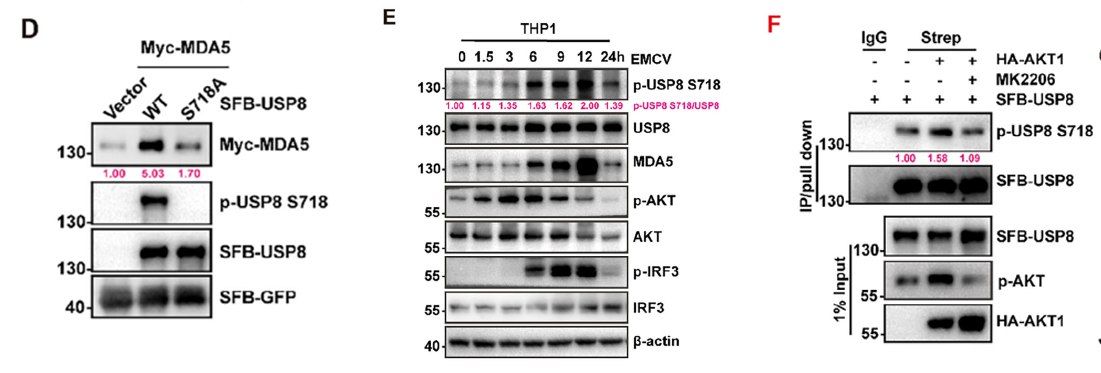
Fig. 1. Detection of USP8 Ser718 phosphorylation using the AtaGenix-produced custom phospho-specific antibody. Adapted from Zhang et al., Adv Sci 2025.
In the study's preclinical models, inhibiting USP8 or AKT effectively suppresses MDA5-induced autoimmunity in AGS mice and reduces excessive immune signaling in anti-MDA5-positive DM and systemic lupus erythematosus (SLE) patient cells, supporting USP8/AKT as a promising therapeutic direction for MDA5-associated autoimmune diseases.
14.3
Impact Factor (Adv Sci)
Ser718
Phospho-Site Targeted
USP8
Deubiquitinase Identified
AGS + DM
Disease Models Validated
Why This Matters
This study establishes USP8 as the missing link in MDA5 regulation, defining a druggable AKT–USP8–MDA5 axis for autoimmune diseases with limited treatment options. The AtaGenix custom phospho-USP8 (Ser718) antibody was the key detection reagent that made it possible to track AKT-dependent phosphorylation dynamics in both viral infection and autoimmune contexts — a tool that did not exist commercially and had to be built de novo for this research program.
Zhang Q, Huang S, He Y, Wang W, Tong C, Ma M, Zhao M, Yi L, Knobeloch K-P, Zhang P. USP8-Governed MDA5 Homeostasis Promotes Innate Immunity and Autoimmunity. Advanced Science. 2025;12(34):e03865. DOI: 10.1002/advs.202503865
Results may vary depending on target, antibody design, and project scope. All proprietary client information is subject to NDA.
Need custom phospho-specific antibodies for signaling pathway validation? AtaGenix delivers site-specific phospho-antibody development with WB/IP/IF validation support.
Talk to Technical SupportResponse within 24 hours

Contact Us

+86-27-65523339

info@atagenix.com

Building C, R & D Building, No. 666, Shendun 4th Road, Donghu New Technology Development Zone, Wuhan