01
Successive waves of transcriptional repression and de-repression license cell cycle progression in an archaeon
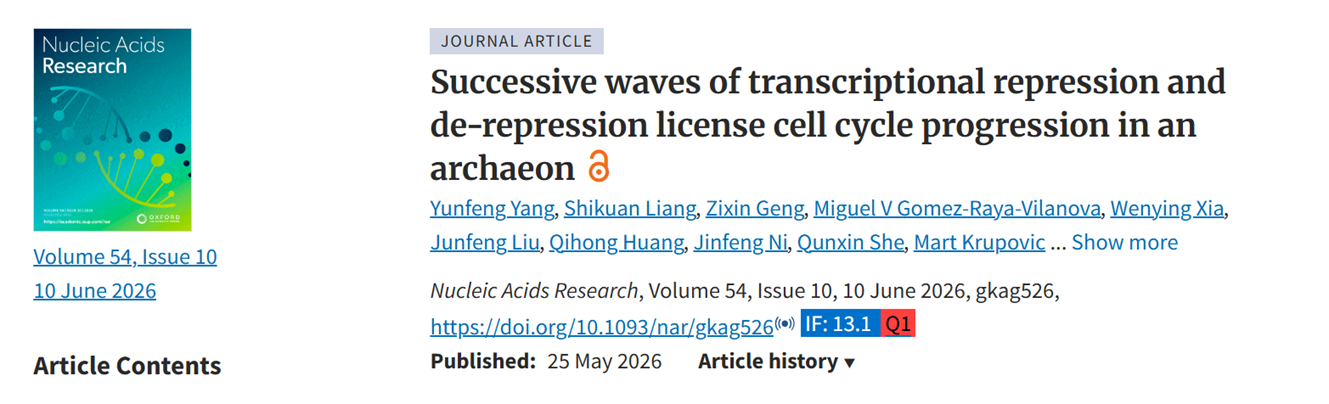
Archaea of the order Sulfolobales share a cell cycle architecture strikingly similar to that of eukaryotes, yet the transcriptional regulatory mechanisms governing their cell cycle have remained poorly understood. Using the thermoacidophilic archaeon Saccharolobus islandicus REY15A as a model, this study identified three ribbon-helix-helix (RHH) domain-containing transcription factors — aCcr1, aCcr2, and aCcr3 — and systematically characterized their roles in cell cycle control. All three function as transcriptional repressors that recognize similar promoter regulatory sequences, but with distinct temporal expression patterns: aCcr2 is constitutively expressed throughout the cell cycle, while aCcr1 and aCcr3 are periodically upregulated at the M/G1 and G1/S transitions, respectively. Mechanistically, the eukaryotic-like kinase aCcrK phosphorylates aCcr2 at Ser24, substantially weakening its DNA-binding affinity and thereby relieving repression of key cell cycle genes to open a window for mitotic entry; aCcr1 subsequently restores repression via its higher promoter-binding affinity, ensuring orderly cell cycle progression. Based on these findings, the authors propose a "phosphorylation-assisted checkpoint" model, arguing that the core logic of cell cycle regulation in Sulfolobales relies on timed repression and de-repression of key genes rather than active transcriptional activation — a mechanism that may represent a simplified evolutionary intermediate between archaeal and eukaryotic cell cycle control.
Polyclonal antibodies against the three core proteins aCcr2, aCcrK, and aCcr3 were custom-produced by AtaGenix. These antibodies were used in two critical experimental applications: Western blot, to track the dynamic expression of each target protein across cell cycle stages; and ChIP-seq, to map transcription factor binding sites at genome-wide resolution. Together, they provided the complete experimental evidence base supporting the "phosphorylation-assisted checkpoint" model.